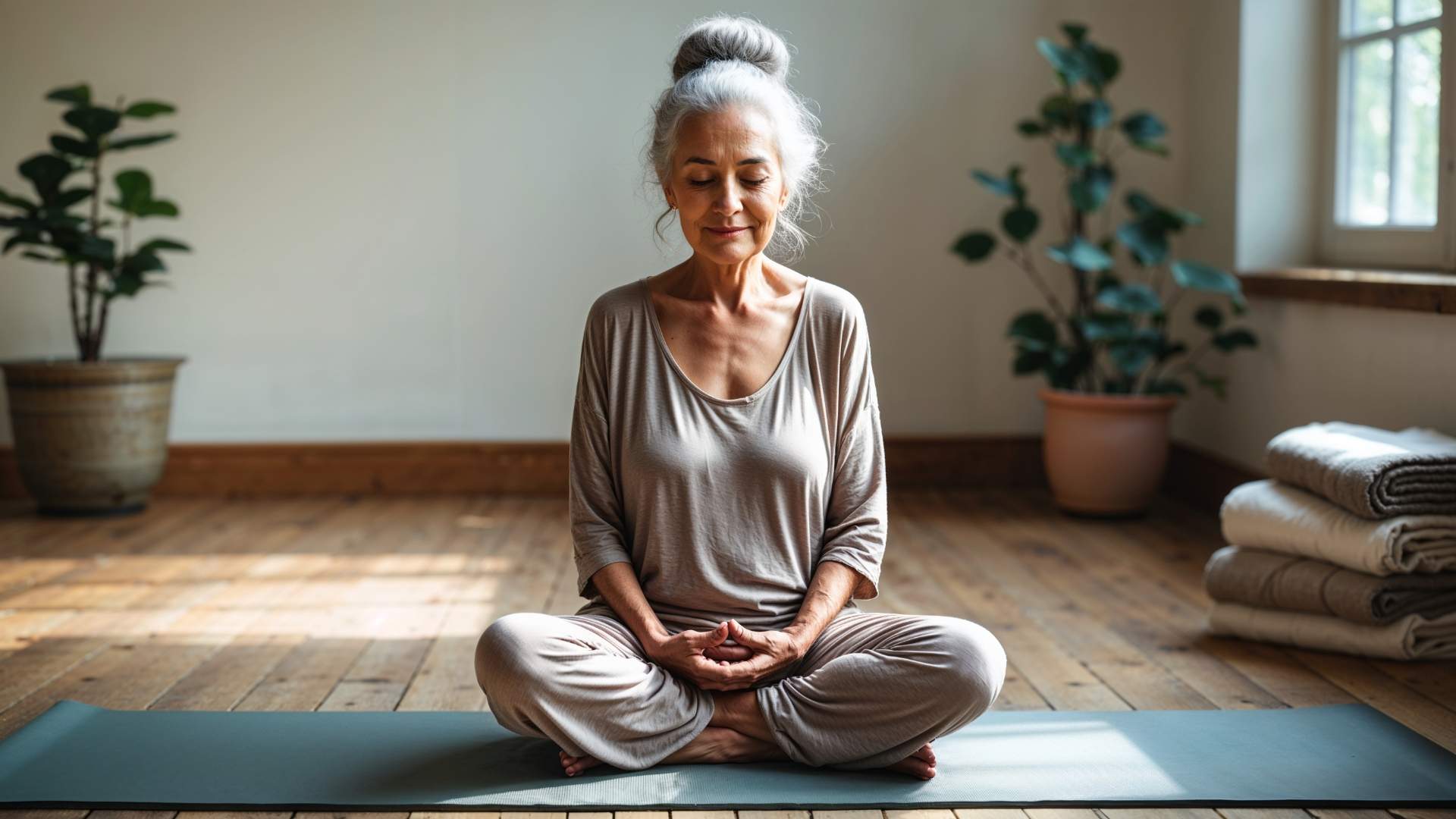
Gentle 28 Day Yoga Challenge For Seniors To Move Better
Have you been thinking about moving more, but don’t know where to start? A 28 day yoga challenge might be just what you need. This challenge isn’t about pushing your limits—it’s about showing up consistently in a way that feels good for your body. It’s designed specifically for seniors who want gentle movement without putting pressure on your joints or forcing your body into complex poses. In just four weeks, you’ll be able to improve flexibility and strength through safe, realistic daily sessions.
Why a 28-Day Yoga Challenge?
The idea of practicing yoga for 28 days might seem odd at first. However, there are solid reasons why this timeframe works particularly well for seniors starting their yoga journey.
The Science of Habit Formation
Research shows it takes about 66 days to form a new habit. While 28 days may not complete the process, it’s long enough to build momentum without being overwhelming. You’ll start noticing improvements in flexibility and strength around week two, which helps keep you motivated through the full four weeks.
Perfect Length for Seniors
Unlike more intimidating 60 or 90-day challenges, 28 days feels achievable. You can see the finish line from day one, which makes it easier to commit. It’s long enough to experience real benefits but short enough that you won’t lose interest or get discouraged.
Measurable Progress
In 28 days, you’ll actually feel the difference. Your morning stiffness may ease up. Getting out of chairs becomes smoother. You might sleep better or feel more balanced when walking. These aren’t dramatic transformations, but they’re the kind of improvements that matter for daily living.
Seasonal Timing
A 28-day commitment works well with your schedule. Whether you’re starting in winter (perfect indoor activity) or spring (preparing for more outdoor activities), four weeks fits naturally into how we think about time and seasons.
Built-in Flexibility
If you miss a day or two, you can easily get back on track without feeling like you’ve failed. The 28-day structure allows for life’s interruptions while still maintaining momentum toward your goal.
Your 28-Day Yoga Challenge Structure
This 28-day yoga challenge is designed to meet you exactly where you are. Each week builds gently on the last, to help your body grow stronger and your breath become steadier.
Sessions are short—just 10 to 15 minutes—and offer options for seated and chair-assisted standing poses.
Daily Practice: Each week features 3-4 core poses. Practice these same poses daily during that week, spending 2-3 minutes on each pose. This repetition helps your body adapt and builds confidence.
Week 1: Getting Comfortable (Days 1–7)
This first week helps you slow down, breathe deeply, and reconnect with your body through simple, seated postures.

Diaphragmatic Breathing
Benefit: Encourages deep relaxation and breath control
- Place one hand on your belly, the other on your chest
- Inhale gently so only your belly rises
- Exhale slowly, feeling your belly fall
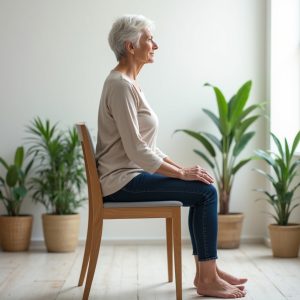
Seated Mountain Pose (Tadasana)
Benefit: Builds posture awareness and calm focus
- Sit tall with feet flat on the floor
- Inhale to gently lengthen your spine
- Exhale and relax your shoulders
- Place your arms slightly away from your body and spread your fingers
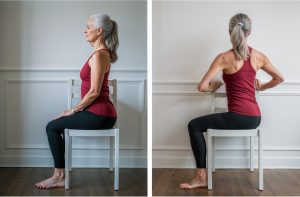
Seated Spinal Twist
Benefit: Improves gentle mobility in the spine
- Sit tall, feet flat
- Place your right hand on your left knee
- Gently twist your torso to the left
- Hold for a few breaths, then switch sides
Week 2: Adding Gentle Strength (Days 8–14)
This week introduces supportive standing poses and seated strengthening postures. Each one is designed to safely activate muscles used in daily life.
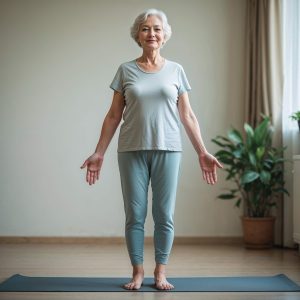
Mountain Pose (Tadasana)
Benefit: Improves balance and posture and cultivates a sense of grounding
- Stand with your feet hip-width apart
- Arms rest gently at your sides
- Toes point straight ahead
- Feel your weight evenly spread between both feet
- Keep knees soft, not locked
- Gently lengthen your spine
- Relax your shoulders down and away from your ears
- Inhale deeply through your nose
- Exhale slowly and feel your body settle
- Stand here for 3–5 calm breaths
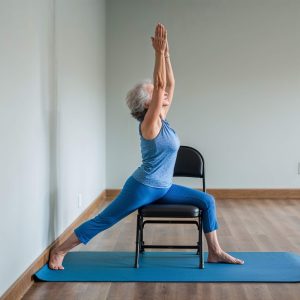
Chair Warrior I
Benefit: Builds leg strength and hip flexibility
- Sit sideways on your chair, so your right side is near the chair back.
- Keep your right foot flat on the floor in front of you.
- Slide your left leg back, keeping the foot on the floor and toes pointing slightly out.
- Keep your chest facing forward over your front leg.
- Lift both arms up toward the ceiling.
- Take a few deep breaths here.
- Slowly lower your arms and switch sides.
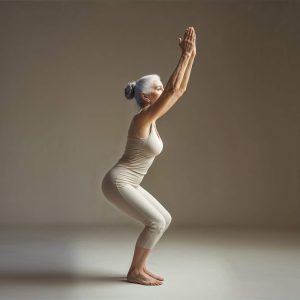
Utkatasana (Chair Pose)
Benefit: Improves posture and gently strengthens legs and core
- Stand tall with feet hip-width apart
- Inhale and lift both arms overhead
- Keep your shoulders relaxed and palms facing each other
- Exhale and gently bend your knees, like you’re about to sit down
- Keep your weight in your heels
- Make sure your knees don’t go past your toes
- Keep your chest lifted and gaze forward
- Stay for 2–3 deep breaths, or less if needed
- To come up, press into your feet and straighten your legs slowly
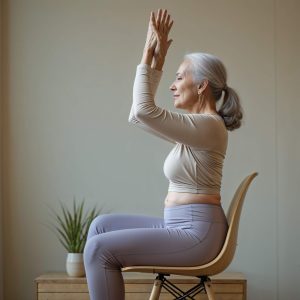
Eagle Arms with Gentle Twist
Benefit: Strengthens shoulders and gently engages the spine
- Sit up tall in your chair.
- Bring your arms out in front of you, like you’re reaching forward.
- Cross your right arm over your left.
- Bend your elbows and try to touch the backs of your hands together.
- Lift your elbows a little. Take a deep breath.
- Hold for a few breaths, then slowly let go and switch sides.
Week 3: Improving Balance & Flow (Days 15–21)
This week connects movement and breath. You’ll explore balance-focused standing poses and calming flows using the chair for support.
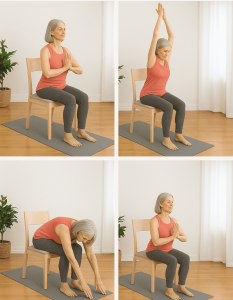
Seated Sun Salutation (Modified)
Benefit: Links breath and movement in a gentle flow
- Start in Seated Mountain Pose, hands at heart center
- Inhale – Sweep arms overhead, lifting through the chest for a light backbend
- Exhale – Hinge at the hips and fold forward over your legs, arms reaching toward the floor
- Inhale – Place hands on shins, lift halfway with a long spine (Seated Half-Lift)
- Exhale – Fold forward again
- Inhale – Slowly roll back up to sitting, arms sweeping overhead
- Exhale – Bring hands back to the heart center
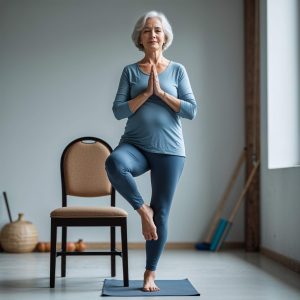
Chair-Supported Tree Pose
Benefit: Builds balance and concentration
- Stand next to a chair, one hand resting on the back
- Place one foot against the opposite ankle or calf (never the knee)
- Stand tall and hold for a few breaths
- Switch sides
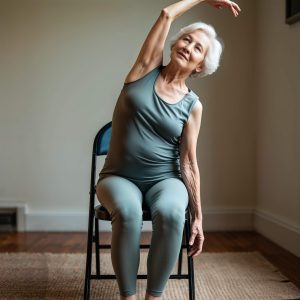
Chair Side Stretch (Parsva Sukhasana)
Benefit: Stretches the waist and improves posture control
- Sit on a chair with your back straight and feet flat on the floor
- Place your left hand on the chair or beside you for support
- Inhale and lift your right arm up and over your head
- Exhale and gently lean to the left
- Keep your torso facing forward and feel the stretch along your right side
- Stay in this position for 10-15 seconds
- Return to the starting position and switch sides
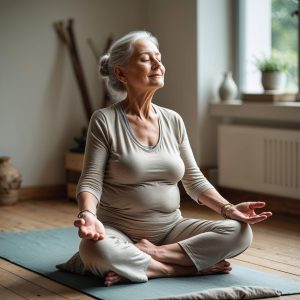
Simple Seated Meditation
Benefit: Helps calm the mind and reset your nervous system
- Sit comfortably on the floor with your legs crossed (use a cushion or folded blanket if needed)
- Keep your spine tall and shoulders relaxed
- Rest your hands gently on your knees or in your lap, palms facing up or down
- Close your eyes softly
- Breathe naturally, in and out through your nose
- Simply observe your breath and how your body feels
- If your mind wanders, gently bring your attention back to your breath
Tip: Sit near a wall for gentle back support if needed. You can start with 2–5 minutes and increase as you feel more comfortable.
Week 4: Bringing It Together (Days 22–28)
This final week blends what you’ve learned into short, flowing sequences with longer holds and deeper calm.
Standing Flow Sequence
This is a sequence that includes some of the poses practiced in earlier weeks.
Setup: Stand in front of a sturdy chair, seat facing you, about arm’s length away.
Benefit: Combines strength, balance, and rhythm
- Begin in Mountain Pose
- Inhale – Sweep arms overhead (add gentle backbend if comfortable)
- Exhale – Hinge at hips, place hands on chair seat (Forward Fold)
- Inhale – Lift chest halfway, spine long (Half Lift)
- Exhale – Relax chest toward chair (Fold Again)
- Inhale – Slowly roll up, arms sweep overhead
- Exhale – Lower arms to sides, return to Mountain Pose
- Repeat the sequence 3–4 times, moving gently with your breath

Seated Child’s Pose
Benefit: Promotes deep rest and stress release
- Sit in a chair with a cushion or a folded towel on your lap
- Fold forward, resting arms and head on the cushion
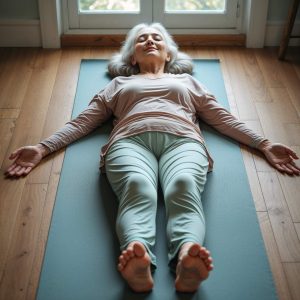
Final Guided Relaxation (Seated Body Scan)
Benefit: Leaves you feeling grounded and renewed
- Lie on your back with arms at your sides, palms up
- Close your eyes and take a slow, deep breath
- Bring awareness to your toes — relax them
- Move your attention slowly up: feet, legs, hips — soften each area
- Relax your belly and chest — feel the breath rise and fall
- Soften your shoulders, arms, and hands
- Gently release tension in your jaw, eyes, and forehead
- Stay here for a few more slow breaths, fully relaxed
Wrapping Up
Don’t stop at 28 days of yoga. Join the Easy Home Chair Yoga for Beginners Digital Class to build on the momentum.
This challenge can be the start of a healthier, more confident lifestyle that extends far beyond these four weeks. You’ll have discovered which movements feel best for your body and built the daily habit that makes everything else possible. By the end of the 28 day yoga challenge, getting out of chairs will feel easier, and your balance will be steadier. Those everyday aches and stiffness that used to greet you each morning will start to fade. Most importantly, you’ll have proven to yourself that gentle, consistent movement creates real change.