
Gentle Arm Exercises for Seniors With Resistance Bands
Arm strength shows up in small moments—carrying shopping into the house, twisting a tight lid, reaching forward without shoulder strain. As you get older, those everyday movements tend to demand more effort. Resistance band-based arm exercises for seniors offer a practical way to maintain or rebuild that strength at home.
The bands create smooth, controlled tension that’s easier on joints than free weights. You adjust the challenge by choosing a lighter or heavier band. That makes them suitable for protecting your shoulders and elbows while you build strength.
Why Resistance Bands Work Well for Seniors
Resistance bands are one of the most versatile equipment for senior fitness. They challenge your muscles without the risk of dropping a dumbbell or straining a joint under too much load. That balance makes them practical for older adults who want to stay strong while protecting their bodies.
Smoother on Your Joints
The tension in a resistance band stays smooth throughout each movement. When you curl your arm with a band, the resistance increases gradually as you pull. Your muscles work steadily from start to finish. Free weights, on the other hand, create more stress at certain angles, which can feel harsh on aging joints. Bands tend to distribute that work more evenly.
Easy to Adjust
You control the difficulty simply by changing bands. A light band offers gentle resistance for beginners or during recovery. A heavier band provides more challenge as you get stronger. You don’t need multiple sets of dumbbells taking up space in your home. One or two bands give you several intensity levels.
Affordable & Portable
Cost matters when you’re on a fixed income. Resistance bands are significantly more affordable than adjustable dumbbells or weight sets. Resistance bands also take up little space. They fold into a drawer or small bag and travel easily. You can use them in a small apartment without moving furniture or setting up equipment.
Safer to Use
The safety advantage is real. If your grip fails during an exercise, the band simply releases tension. A dropped weight can cause injury. That peace of mind helps you focus on proper form instead of worrying about accidents. Your confidence grows when you know the equipment won’t hurt you if something goes wrong.
Works with Your Limitations
Bands work well for people managing arthritis, past shoulder injuries, or joint replacements. The progressive resistance lets you ease into movement without sudden force. You can start with minimal tension and add more only when your body feels ready.
A clinical research study involving older adults with degenerative joint conditions found that resistance-band exercises led to greater improvements in pain and function than standard physical therapy alone, in a controlled intervention study. Starting with light resistance and progressing gradually helps you build strength without aggravating existing conditions.
Choosing the Right Resistance Band
Not all resistance bands work the same way. The type you choose affects how comfortable the exercises feel and how well they target your arms.
Types of Resistance Bands
- Loop bands form a complete circle without handles. They work well for arm exercises because you can grip them at different points to adjust resistance. Most come in sets with varying resistance levels.
- Tube bands with handles attach to foam or plastic grips at each end. The handles make them easier to hold if you have arthritis or weak grip strength.
- Therapy bands look like flat sheets of latex or fabric. They offer the lightest resistance and work well if you’re just starting out.
For a detailed breakdown of the best resistance bands for seniors, including brand recommendations and what to look for in quality, read our complete guide to choosing resistance bands.
Understanding Your Arm Muscles
Your arms contain several muscle groups that work together during daily activities. Knowing what each muscle does helps you understand why strengthening them matters for independence.
Biceps: Your Elbow Benders
The biceps sit on the front of your upper arm and bend your elbow. They help you lift grocery bags, pull open doors, or bring a cup to your mouth. When your biceps are weak, these pulling movements may feel harder.
Triceps: Your Elbow Straighteners
The triceps run along the back of your upper arm and straighten your elbow. They activate when you push up from a chair, press open a heavy door, or place items on a shelf. Strong triceps help you catch yourself if you start to fall forward.
Deltoids: Your Shoulder Movers
Your deltoid muscles cap each shoulder and lift your arms in different directions—out to the side, forward, and backward. Reaching into a high cabinet, hanging laundry, or waving to someone all require healthy deltoids.
Forearm Muscles: Your Grip Controllers
The muscles in your forearms control your wrists and fingers. They generate the force you need to grip doorknobs, twist jar lids, and hold onto handrails. Strong forearms mean your hands feel more capable, and your grip stays secure longer.
These muscle groups work together during most arm movements. Lifting a pot uses your biceps to bend your elbow, your deltoids to raise your arm, your triceps to extend it, and your forearm muscles to maintain your grip. When one group is weak, the others compensate. That imbalance can lead to strain or awkward movement patterns.
5 Resistance Band Arm Exercises for Seniors
The following exercises target the major muscle groups in your arms. Each one includes clear steps and rep suggestions. Start with a light resistance band and focus on proper form before adding intensity.
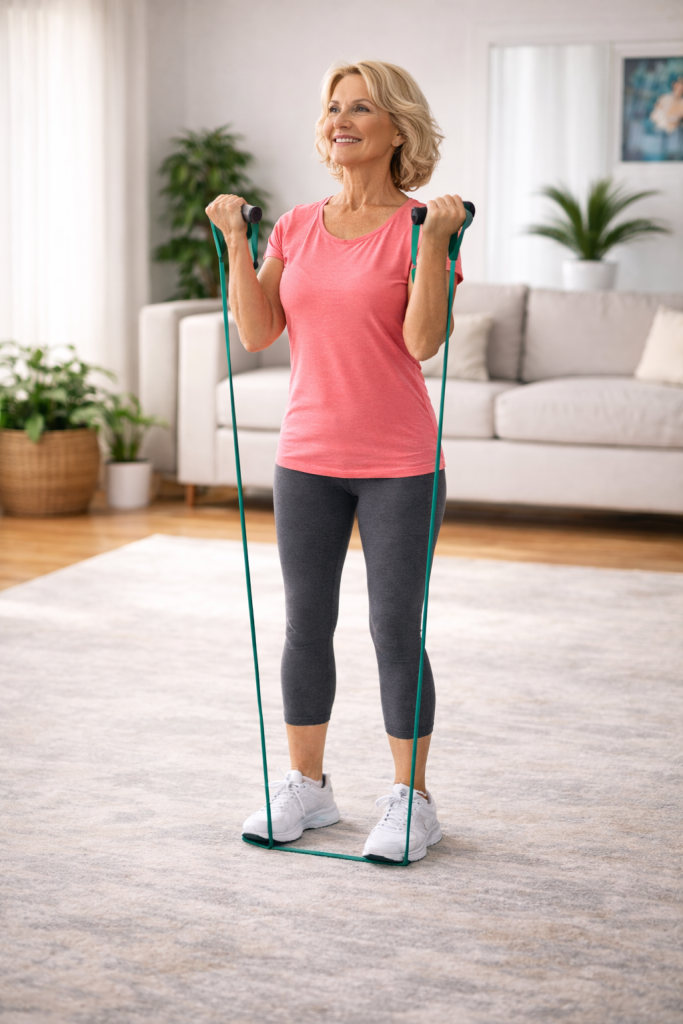
Bicep Curls
Target muscles: Biceps, forearms
How to do it:
- Stand with both feet on the center of the band, hip-width apart.
- Hold one end of the band in each hand with your palms facing forward.
- Keep your elbows close to your sides and curl your hands toward your shoulders.
- Squeeze your biceps at the top for one second.
- Slowly lower your hands back to the starting position.
Goal: 8-12 reps, 2 sets
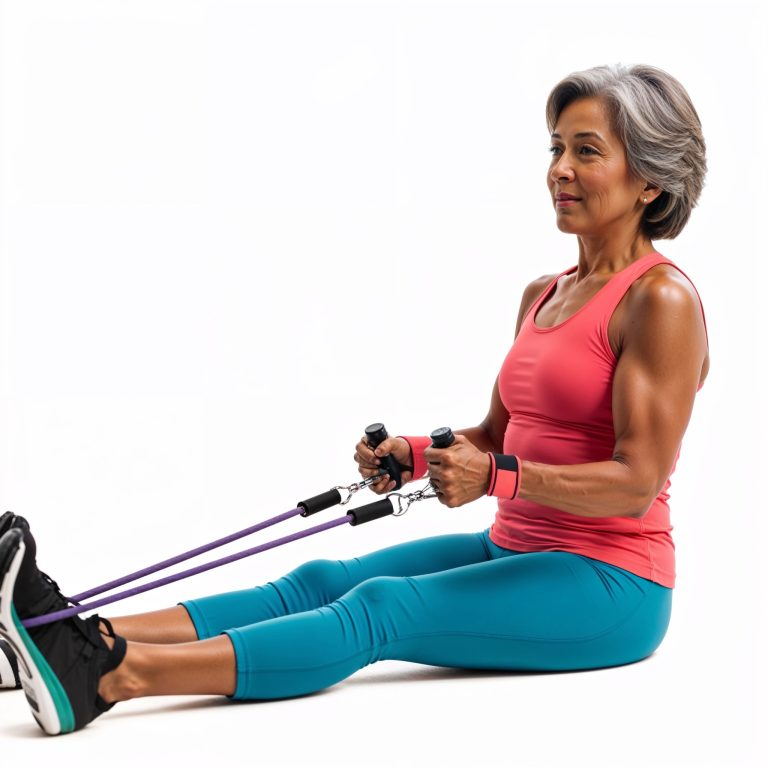
Seated Resistance Band Rows
Target muscles: Upper back, biceps, rear shoulders
How to do it:
- Sit in a sturdy chair with your legs extended in front of you.
- Loop the band around the soles of both feet.
- Hold one end of the band in each hand with your arms extended forward.
- Pull both hands toward your ribcage, squeezing your shoulder blades together.
- Keep your elbows close to your body as you pull back.
- Slowly return your hands to the starting position.
Goal: 8-12 reps, 2 sets
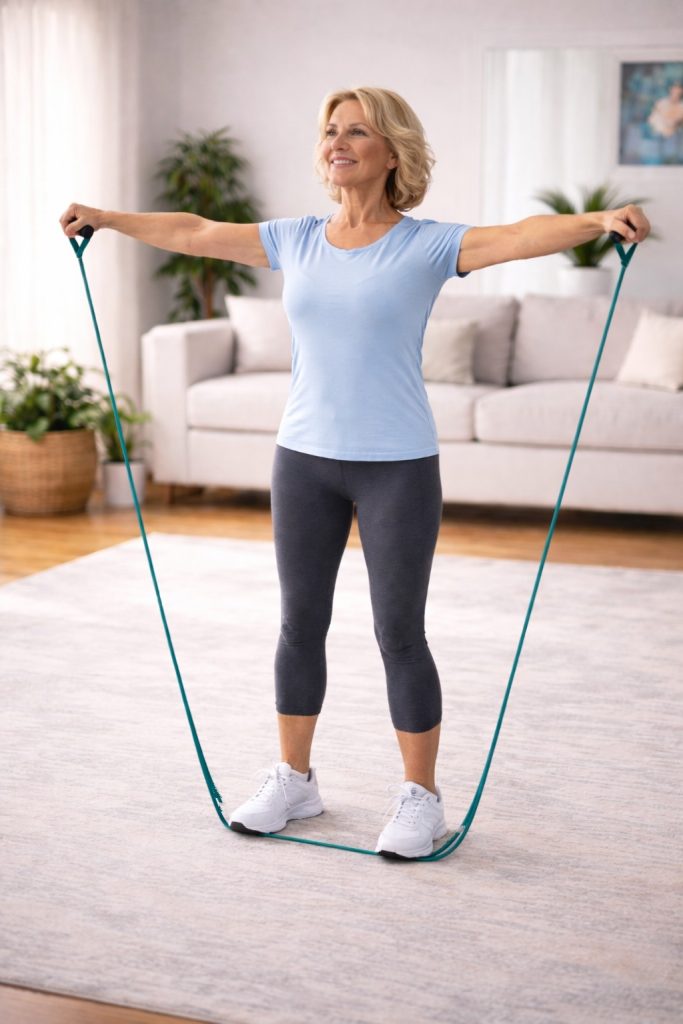
Lateral Shoulder Raises
Target muscles: Deltoids (shoulders)
How to do it:
- Stand with both feet on the center of the band, hip-width apart.
- Hold one end in each hand with your arms at your sides and palms facing in.
- Lift both arms out to the sides until they reach shoulder height.
- Keep a slight bend in your elbows throughout.
- Slowly lower your arms back to your sides.
Goal: 8-12 reps, 2 sets
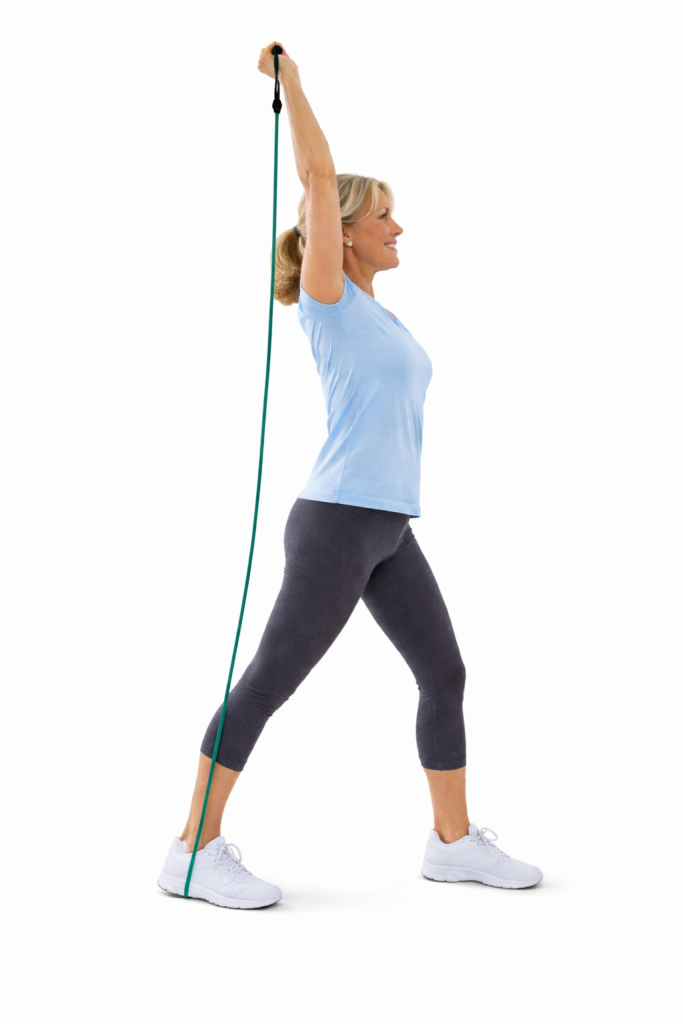
Overhead Tricep Extensions
Target muscles: Triceps
How to do it:
- Stand or sit with one foot on the center of the band.
- Hold one end of the band in your working hand behind your head.
- Your elbow should point toward the ceiling with your hand near your neck.
- Straighten your arm overhead, extending through the elbow.
- Keep your upper arm still and close to your head.
- Slowly return to the starting position.
Goal: 8-12 reps each arm, 2 sets
Form tip: Move only at the elbow, not the shoulder
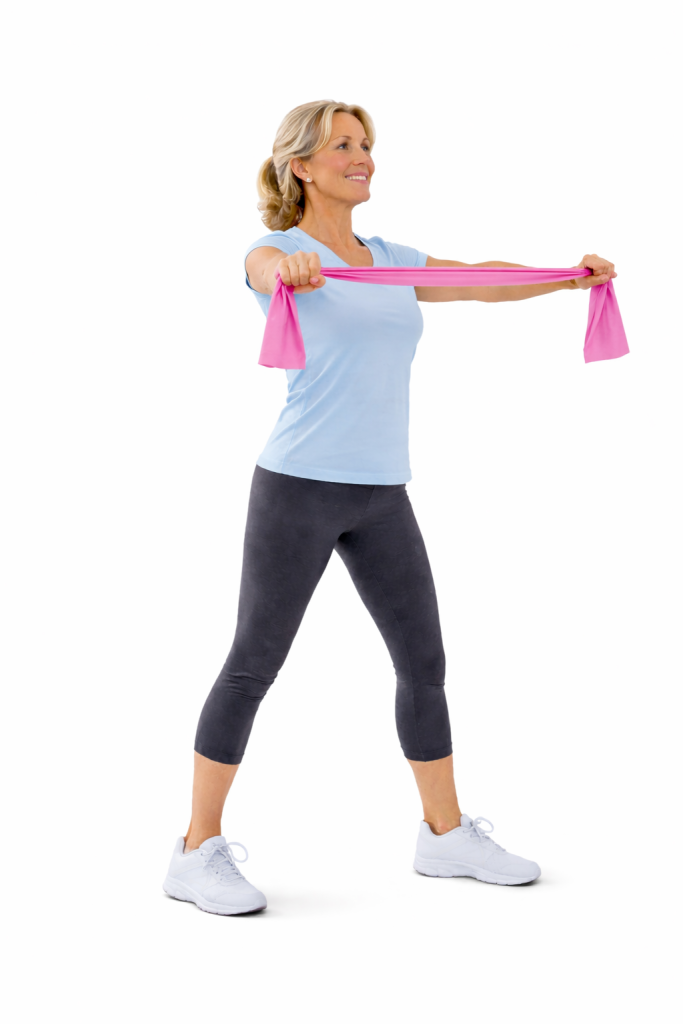
Band Pull-Aparts
Target muscles: Upper back, rear shoulders
How to do it:
- Stand or sit holding the band in both hands at chest height.
- Your arms should be straight with hands about shoulder-width apart.
- Pull the band apart by moving your hands out to the sides.
- Squeeze your shoulder blades together at full stretch.
- Keep your arms at chest height throughout.
- Slowly bring your hands back together.
Goal: 10-15 reps, 2 sets
Common Mistakes to Avoid
Learning proper form protects your joints and helps you get the most from each exercise. Watch for these common errors.
- Locking your elbows. Keep a slight bend at full extension to protect the joint and keep tension on your muscles.
- Using momentum to complete reps. Swinging or jerking reduces how much your muscles work. Move slowly and with control.
- Holding your breath during exercises. Exhale as you exert effort and inhale as you return to the starting position. Holding your breath can spike your blood pressure.
- Gripping the band too tightly. A firm grip is good, but squeezing too hard fatigues your forearms and can cause cramping.
- Skipping the warm-up. Cold muscles are more prone to strain. Spend three to five minutes doing gentle arm circles and shoulder rolls before you start.
- Pushing through sharp pain. Muscle fatigue is normal, but sharp or shooting pain signals a problem. Stop immediately if you feel pain in your joints.
- Using worn or damaged bands. Check your bands before each use for tears or thin spots. Replace bands that show damage or have lost their elasticity.
Building Arm Strength at Your Own Pace
If you’re ready to put your resistance bands to work with expert guidance, our Gentle Seated Band Exercises Digital Class walks you through a complete routine. You’ll follow along with clear instructions on proper form, learn how to pace yourself, and build a consistent practice that strengthens your entire body—not just your arms.
With these resistance band arm exercises for seniors, you can now work on strengthening your biceps, triceps, shoulders, and forearms. These exercises can help you maintain independence and make daily tasks easier. Start with light resistance, focus on proper form, and listen to your body as you build strength at your own pace.