
How To Safely Start Building Muscle After 60
In your 60s, the goal is to live with strength, ease, and optimal independence. You want to be able to carry your groceries without strain, get up from your favorite chair with ease, and climb stairs without feeling winded. One of the most effective ways to support these is by building muscle after 60 gently and consistently. So if you’re wondering if you can still build muscle after 60… the answer is yes. You definitely can
This guide offers a holistic approach to effectively building muscle in your senior years. It combines elements of nutrition and exercise to position you for stronger muscles, better stability, and renewed physical confidence.
Why Building Muscle After 60 Matters
The body naturally loses muscle as we age. According to the U.S. Department of Health and Human Services, people lose up to 5% of their muscle mass each decade after age 30. This means that muscle loss is a progressive process, and its overall effect becomes more noticeable in your 60s and beyond.
This gradual loss, called sarcopenia, is why everyday tasks start feeling harder. But the good part is that this process can be slowed, stopped, and even reversed through targeted lifestyle changes. By actively building muscle after 60, you can counter the common symptoms of sarcopenia, such as falls, slow walking speed, and general muscle weakness.
5 Exercises for Building Muscle After 60
To build muscle after 60, you need a combination of strength training and proper nutrition. One without the other won’t give you lasting results. While many seniors shy away from exercising because of the fear of injuries, you can exercise safely and injury-free with the right approach.
Below are some safe and senior-friendly strength training exercises that can help you build muscle:
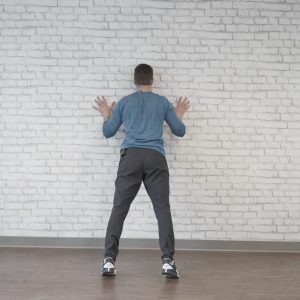
Wall Push-Ups
Benefit: Builds strength in the chest, shoulders, and arms without putting pressure on your joints.
How to do it:
- Stand facing a wall, about an arm’s length away.
- Place your palms on the wall at shoulder height, slightly wider than shoulder-width apart.
- Keep your body in a straight line from head to heels.
- Slowly bend your elbows and lean toward the wall.
- Pause briefly, then push back to the starting position.
- Breathe out as you push, and in as you lower.
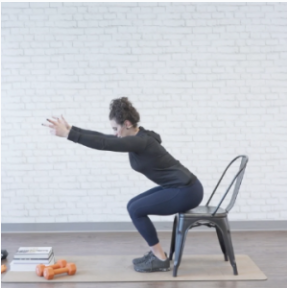
Chair Squats
Benefit: Strengthens your thighs, hips, and glutes — helping with standing, walking, and balance.
How to do it:
- Stand in front of a sturdy chair with feet shoulder-width apart.
- Extend your arms out in front for balance if needed.
- Slowly bend your knees and lower yourself as if you’re about to sit.
- Hover just above the seat, then push through your heels to stand back up.
- Use the chair for support if needed.
- Keep your chest up and knees behind your toes.
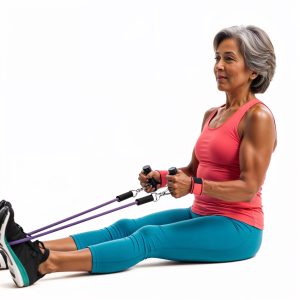
Seated Rows with Resistance Band
Benefit: Strengthens your upper back and arms, which supports good posture and reduces shoulder tension.
How to do it:
- Sit on the floor (or on a firm chair if the floor is uncomfortable).
- Extend your legs and loop a resistance band around your feet.
- Hold the ends of the band with your palms facing each other.
- Sit tall with shoulders down and back.
- Pull the band toward your torso, bending your elbows close to your sides.
- Squeeze your shoulder blades gently together.
- Slowly return to the starting position.
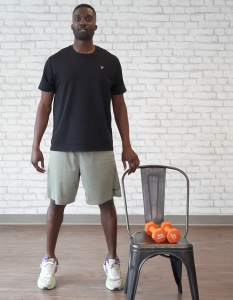
Standing Calf Raises
Benefit: Builds lower leg strength and improves balance and walking stability.
How to do it:
- Stand tall near a wall or chair for support.
- Place your feet hip-width apart.
- Slowly rise up onto your toes as high as is comfortable.
- Pause at the top for a second.
- Lower your heels back to the ground with control.
- Keep your movements slow and steady.
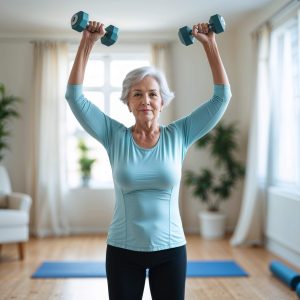
Overhead Press (With Light Weights)
Benefit: Strengthens the shoulders and upper arms — useful for lifting, reaching, and daily upper-body tasks.
How to do it:
- Sit or stand with a light weight in each hand at shoulder height.
- Keep your elbows bent and palms facing forward.
- Press both arms upward until fully extended (but don’t lock your elbows).
- Pause, then slowly lower the weights back to shoulder height.
- Breathe out as you press up, and in as you lower down.
Modification: You can do the press with one hand at a time.
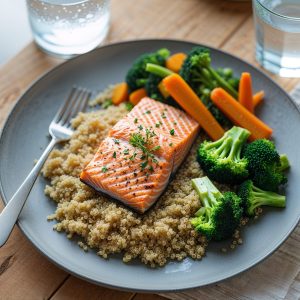
What to Eat to Support Muscle Development After 60
Muscle doesn’t grow during exercise; it actually grows after, when your body repairs itself. That process needs fuel, especially protein and plenty of fluids.
Without enough of the right nutrients, your body may struggle to rebuild the muscle you’ve worked so hard to stimulate. Protein is especially important because it provides the building blocks your muscles need to recover and grow stronger. And staying hydrated helps your body absorb nutrients and keep joints and tissues healthy.
A study showed that dietary protein intakes were significantly lower in elderly groups, with more than 40% failing to meet the recommended intake levels. To avoid falling into this gap, aim to include a source of protein in every meal — even small additions can make a big difference over time.
Simple foods like eggs, beans, lentils, fish, chicken, tofu, and Greek yogurt offer reliable protein without the need for complicated recipes. Spread your intake throughout the day instead of having it all at once, as this helps your body absorb and use it more effectively.
In some cases, if you’re struggling to get enough protein through food alone, a protein supplement may be helpful. But not all supplements are created equal, and they’re not always necessary. Talk to your doctor or a registered dietitian before adding one to your routine. They can help you choose a safe option that fits your individual needs.
Wrapping Up
If you’re ready to put all of this into action safely and at your own pace, the Full Body Fitness & Strength For 55+ Digital Class is your ideal next step.
Building muscle after 60 doesn’t require long hours in a gym or intense workouts. What matters most is consistency. Every rep, stretch, and protein-rich meal moves you closer to greater strength, balance, and independence. You might not see results overnight, but over time, you’ll feel the difference in how you move, carry, bend, and rise.